The Battle of the Atlantic: Allied Naval Intelligence in World War II

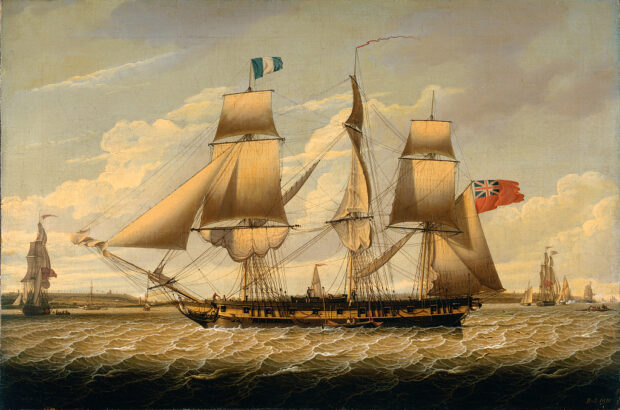
Freedom of the Seas,
Montegue Dawson, oil on canvas, The Mariners' Museum
 
Commander Rodger Winn, RNVR, Director, Submarine Tracking Room—Admiralty OIC,
U.S. Navy photograph in the collections of The Mariners' Museum

Commander Kenneth A. Knowles, USN, Officer in Charge—U.S. Navy F-21 "Atlantic Section" Tracking Room, Tenth Fleet,
U.S. Navy photograph in the collections of The Mariners' Museum
During the Battle of the Atlantic, the Allies used intelligence about Axis forces first to safeguard merchant shipping and then as a means of attacking enemy forces with precision. The triumph of Anglo-American cooperation resulted in the solution of Axis codes and ciphers during the war. Intelligence derived from codebreaking provided the Allies with valuable insight into the most sensitive aspects of Axis strategy and operations. At a more tactical level, the information supplied by the Allied codebreakers was most useful when correlated with other intelligence clues about the Axis enemy. Thus, Anglo-American strategists created tracking rooms where all sources of information on Axis submarine and surface vessel movements were compiled. Commanding the submarine tracking rooms of their respective services, Royal Navy Reserve Commander Rodger Winn and U.S. Navy Commander Kenneth Knowles collaborated to maintain a comprehensive intelligence picture of Axis operations in the Atlantic, Indian Ocean, and other naval theaters as well. Together, Winn and Knowles fostered an atmosphere of Anglo-American cooperation that Winn's wartime assistant, Patrick Beesly, once described as "probably closer than between any other British and American organizations in any [s]ervice and in any theater."

To perform their missions, Winn and Knowles correlated information from all sources with highly classified signals intelligence—including information derived from cryptologic special intelligence. Such information was commonly classified under the codenames ULTRA and MAGIC, though other classifications were also used. Always security-conscious, Knowles wrote in April 1945 that "[i]n order to protect sources of information it is strongly recommended that these F-21 and [Admiralty] serials either be destroyed or their security classification raised" to a level of secrecy precluding access "...to various officers and civilian historians who may examine these files." Fortunately, the records were mostly preserved intact and eventually housed in sequestered storage facilities in the United States and Britain.

British Prime Minister Winston Churchill and First Sea Lord Sir Dudley Pound in London, circa 1942,
U.S. Navy photograph in the collections of The Mariners' Museum
 
Fleet Admiral Ernest J. King, USN,
U.S. Navy photograph in the collections of The Mariners' Museum

Winn and Knowles were essential figures in developing and maintaining Anglo-American cooperation during the war. Winn and Knowles first established their war-winning relationship during the Drumbeat crisis of 1942. After Anglo-American intelligence officials negotiated preliminary arrangements to collaborate in collecting special intelligence on Axis forces in April, Knowles was dispatched to work in Winn's tracking room. Studying under Winn in the Admiralty Operational Intelligence Center (OIC), Knowles gained vital experience using Winn's pioneering methods. Returning from Britain to reorganize the U.S. Navy's "Atlantic Section" that fall, Knowles freely shared information and opinions with his British counterpart and friend, Winn. Working together, Winn and Knowles created a forum where British and American strategists could unify the Allied naval command through secure communication. For example, the Admiralty First Sea Lord and U.S. Navy Chief of Naval Operations and Commander in Chief (COMINCH) Admiral Ernest J. King often communicated directly with one another through the secured communiqué transmitted on a daily basis between the Winn and Knowles tracking rooms after 1943.

Many histories depict American leaders like Admiral King as being indecisive during the Drumbeat crisis. However, newly released documents largely undermine negative portrayals of King. Wartime documents clearly reveal King's behind-the-scenes efforts to establish key relationships within the British and American intelligence services. Like his British counterparts, King understood the importance of special intelligence in defeating U-boats. Hoping to develop an intelligence advantage, he placed a high priority on solving the M4 Enigma and aggressively supported U.S. Navy codebreaking and cryptologic efforts with money, personnel, and political clout. King ultimately authorized Knowles to study under Winn in the summer of 1942. By October, King supported a key U.S. Navy codebreaking decision-maker, Commander Joseph Wenger, as he negotiated war-winning arrangements with Royal Navy Captain Edward Travis, Director of GC&CS. Together, they agreed to streamline Allied intelligence gathering. As a result of the Travis and Wenger arrangements of 1942, Anglo-American codebreakers could effectively pool their intellectual and technical resources to solve the four-rotor Enigma and TRITON.

Page 1 of 3 | Next >>

Home | Hunters & Hunted | Allied Intelligence | Enigma
Allied Cooperation | Virtual Enigma | Solving EnigMail | Hunter-Killers
Capture U-505 | Special Intelligence | Bibliography


[ Navigation Bar ]

Copyright © 2000 The Mariners' Museum. All Rights Reserved.