Portuguese Explorers Terms

Moors
Also known as Muslims. People who follow the Islamic religion founded by the prophet, Mohammed.

Prestor John
Fabled priest and ruler of a vast kingdom somewhere in the Far East or Africa. He was supposedly a Christian king who would be an ally of the European monarchs. No one had ever seen him or knew where his kingdom was located. He influenced Portuguese explorers who sought him during their travels.

Ottoman Turks
Led by the Sultan of Turkey, these people dominated Syria, Egypt, Iraq, the Barbary states, the Balkan states, and parts of Hungary and Russia. The Ottoman Empire lasted from the thirteenth century to World War I.

Bartolomeu Dias (b. ca. 1450 - d. 1500)
Portuguese navigator who discovered the Cape of Good Hope and probably named it. He set the stage for explorers following him to reach India by sea. Dias died at sea when his ship sunk in a squall in the south Atlantic in May, 1500.

Pope Nicolas V (b. 1397 - d. 1455)
Was Pope from 1447 until his death. He was called "the Great Humanist." He restored Rome to make it a center of art, literature, and Christianity. While he was Pope, he had the Vatican renovated.

Cog
A twelfth-century Northern European trading vessel that was clinker-built and square-rigged.

Square Rigged
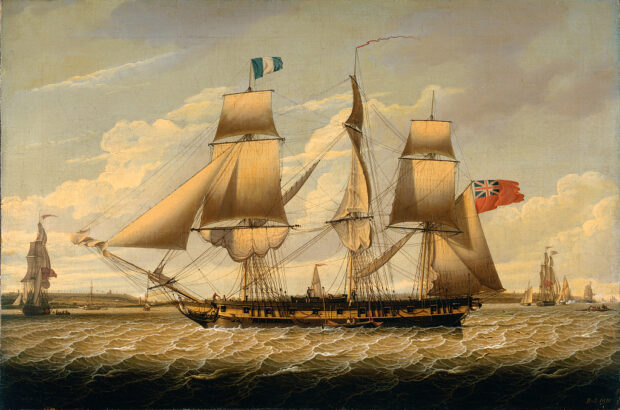
Square or rectangular sails on two or more masts.

Mast
A vertical pole usually made of wood or metal that supports the sails.

Caravel
A small three-masted vessel developed in the fourteenth century. This adaptable ship could be rigged with lateen- or square-rigged sails. The Nina was one of these.

Lateen Rigged
A triangular sail set at an angle to a short mast. Northern Europeans who went to the Mediterranean named them after the word "latin."

Clinker
The edges of the planks are overlapped to form an irregular exterior, much like siding on a house. Also called lapstrake.

Ballast
Any heavy material such as lead, concrete, or stones placed low in a vessel to increase stability.

Dhow
A long, flat sailing vessel that is lateen-rigged and found in the Indian Ocean along the east coast of Africa, the Arabian peninsula, Pakistan, and India.

Fore
The front part of a ship.

Mainmast
On ships with two or more masts, it is the secondmast.

Mizzenmast
The third mast on ships with three or more masts.

Keel
The backbone of a ship. The lowest and principle timber of a wooden ship and to which the stempost, sternpost, and ribs are attached.

Deck
Floors on a ship. Each level is called a deck.

Poop
A partial deck above the main deck located aft.

North Star
A second magnitude star found at the end of the handle of the Little Dipper and almost at the north celestial pole. Also called the Pole Star or Polaris.

Quadrant
A simple instrument for determining the altitude of heavenly bodies It is a quarter of a circle with a plumb bob suspended from its apex. Held vertically and aligned with the sun or a star, the plumb line (string with a weight on it) falls across the scale of degree markings from 0-90 degrees on the curved edge, indicating the angle of elevation.

Astrolabe
(From the Greek "astrer" [star] and "labin" [to take].)
An astronomical instrument used by ancient Greeks and others to measure the height above the horizon of celestial bodies. The Seaman's astrolabe was a simple device used for measuring the altitude of the sun or a star for fixing one's approximate latitude. It consists of a heavy brass ring fitted with an alidade or sighting rule pivoted at the center of the ring. Suspended vertically from a shackle at the top of the ring, the alidade was positioned to sight the sun or star and the angle was read off on-scale marks on the ring.

Cross-Staff
An early sixteenth-century instrument for measuring the altitude of a heavenly body. It consists of a square shaft and a sliding cross-piece set at right angles to the shaft. The shaft end is held at the observer's eye and the cross-piece positioned to line up with the sun and the horizon. The cross-piece marks a point on the shaft that is referred to in a table of degrees and minutes.

Longitude
Imaginary lines that run north to south on the surface of the earth. The prime meridian is 0 degrees. Each 15 degrees of longitude equals one hour of time.

Chronometer
A mechanical device for keeping time independent of ship's motion. See Captain Cook.

Compass
An instrument whose magnetized metal needle aligns itself with the magnetic fields of the earth. This causes one end of the needle to point north. Mariners used this information to navigate the ship. The Chinese are said to have invented the first compass over 2000 years ago. See Lodestone.

Dead Reckoning
Deductive reckoning. Estimating location and speed using a variety of different methods including wind, waves, bird sightings, and current.

Stern
The back of a vessel.

Traverse Board
An old and approximate means for recording the course of a ship during a watch four-hour period of time. It consisted of a piece of wood marked out with a compass rose and eight holes bored along each point. Every half-hour (by sand-glass time) a peg was inserted into a hole marking the compass point on which the ship had run. At the end of the watch, the mean course during the watch was determined from the position of the eight pegs.

Chart
A map displaying various graphic representations. Often these are maps of waterways. Early versions of these water charts were called portolans.

Meridian
A great circle passing through the poles and denoted in degrees of longitude east and west of Greenwich, England.

Latitude
Imaginary lines running east to west on the surface of the earth. The latitude determines location north or south on the globe.

Ptolemy (b. 100 A.D. - d. 170 A.D.)
Greek-Egyptian scientist who wrote several books on astronomy, geography, physics, and mathematics. His books on geography were in standard use for 14 centuries. Ptolemy used mathematics to plot the known world. His calculations of latitude and longitude, however, were incorrect.