| Christopher Columbus |
 |
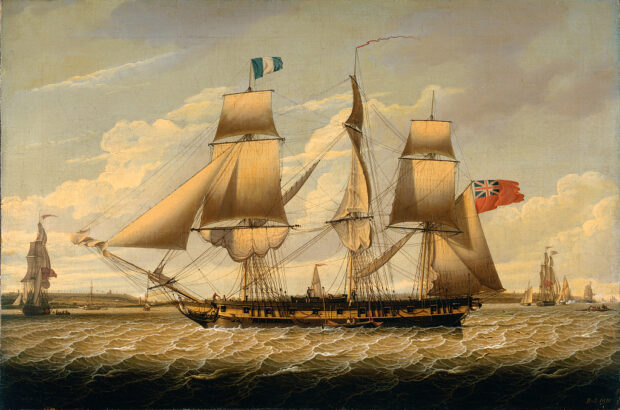
Columbus departed
Palos, Spain, with three ships on August
3, [1492]. The Nina, a lateen-rigged
caravel, was captained by Martin
Alonzo Pinzon. The Pinta,
a square-rigged
caravel was captained by Pinzon's
brother, Vicente
Yanez. The Santa Maria,
a nao, was Columbus' flagship. The nao was large and had a round hull compared
to the lightly built caravels with narrow
hulls. The Santa Maria was slow and unwieldy
during the long ocean voyage. She had a
huge square sail on her main mast, a smaller
one on the foremast, and a lateen-rigged sail on the mizzenmast on the high poop at the stern.
The three ships together carried 104 men
with equipment for repairing ships, and
supplies. |
 |

Martin Alonzo Pinzon |
 |

Vincente Yanez |

Nina |
 |
After a stop
at the Canary Islands off the west coast
of Africa, Columbus had the Nina converted to square sails because it was
lagging behind. The crews loaded fresh water
and fruit aboard. On September 6, 1492,
the ships got underway, sailing into uncharted
seas, out of sight of land.
Columbus' ships covered approximately 150
miles a day. His seafaring instincts were
extraordinary. His crews used a compass for direction and a chip log (a knotted
line with a wooden weight attached at the
end) to measure speed. |
A sailor counted how many knots were let off
the reel in the time allotted. Multiplying the
average rate of a ship's speed by a fixed amount
of time gave a rough estimate of the distance
traveled. Columbus, however, relied on dead reckoning,
meaning he used his experience, intuition, observations,
and guesswork to determine his ships' positions.
Life
Aboard Ship
Columbus' crew worked in four-hour shifts measured
by eight turns of the half-hour ampolletas (sandglasses).
Their duties included pumping bilge,
cleaning the deck, working the sails and checking
the ropes and cargo. When they were off duty,
they slept anywhere they could find space. Columbus
himself often spent days without sleep. Only the
captain had private quarters.
The sailors' lives were hard, and they often
died from disease, hunger, and thirst. Religion
was the central focus of their lives. Every day
began with prayers and hymns and ended with religious
services in the evenings. The crew received one
hot meal a day cooked over an open fire in a sandbox
on deck. Their diet consisted of ship's biscuit,
pickled or salted meat, dried peas, cheese, wine,
and fresh-caught fish.
Land is Sighted!
| The greatest obstacle
to Columbus was the crew's beliefs and superstitions.
They believed the earth was flat, that the
sea was full of monsters, that there were
places where the sea was at the boiling point,
or there were endless whirlpools. The voyage
lasted longer than Columbus expected. After
days with no sight of land, the crew grew
restless and Columbus had to use all manner
of discipline to keep them in line. He offered
a hefty reward to the first man to sight land.
On October 12, a sailor aboard the Pinta sighted land in the present-day Bahamas.
Columbus set foot on land he believed to
be an island in Asia and named it San Salvador.
The adventurous explorer did not find the
riches he expected, so he sailed in search
of China. He visited the island of Cuba
and then an island later called Hispaniola
(shared today by Haiti and the Dominican
Republic). |
|

Pinta |
Everywhere he
went, he encountered native people he called
Indians. (He assumed they were inhabitants
of the Indies.) Initially, relations between
the newcomers and the Indians were friendly.
On November 21, 1492, Captain Pinzon of
the Pinta sailed away to explore
on his own. This was unfortunate for Columbus
because on Christmas day the Santa Maria ran aground and wrecked off the coast of
Hispaniola. Due to limited space on the
remaining ship, the Nina, Columbus
was forced to leave about 40 men behind
on the island. They built a fort named Navidad
and on January 4, 1493, Columbus set sail
for Spain. He arrived in Palos, Spain, on
March 15 to a hero's welcome.
See
a map Columbus's first voyage.
|
 |

Santa-Maria |
Columbus | 1st voyage | 2nd voyage | 3rd
voyage | 4th voyage | Columbus' death
|