| Henry Hudson |
 |
Henry Hudson was an Englishman and accomplished
navigator and sailor. It is unknown where and
when he was born, but his four ocean voyages put
his name on several places on the global map.
On May 1, [1607], Hudson set sail from England
aboard the Hopewell with his son and 11 crewmembers.
He and his crew sailed closer to the North Pole
than any other explorers. He was looking for a
Northwest Passage to the Orient and found there
was no way through the North Pole. He eventually
returned to England.
On April 22, 1608, he set sail once again aboard
the Hopewell and discovered that as he rounded
the northern tip of Norway, the sun shone 24 hours
a day during the Arctic summer. He still failed
to find a Northwest Passage.
In 1609, he moved to Holland and sailed for the
Dutch East India Company. The Dutch provided him
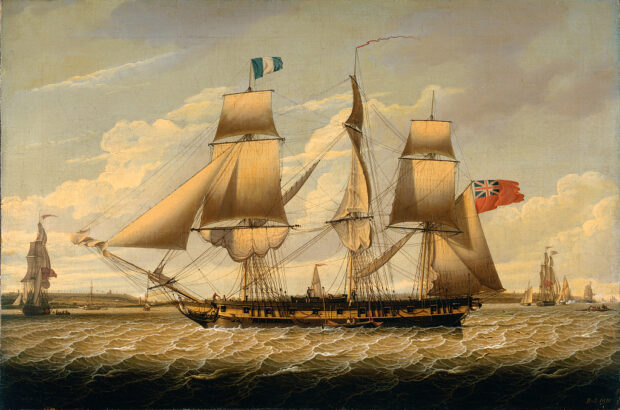
with a ship called the Half Moon and a crew. Hudson
chose some Englishmen to join the Dutch for a
total of 18 crewmembers. The Half Moon was a flat-bottomed
ship only 60 feet long.
In April, [1609], the Half Moon set sail from
Amsterdam and headed north. As the weather worsened
and grew colder, the crew started to grumble and
talk of mutiny. Hudson turned the ship around
and headed south. He ended up off the coast of
present-day Maine and sighted the area today known
as Cape Cod. The Half Moon headed further south
and sailed to the Chesapeake Bay. Hudson then
turned north off the coast of present-day New
Jersey. In September, 1609, the ship dropped anchor
in the harbor of a great river known today as
the Hudson. The crew traded with the Indians and
explored the length of the river. The new lands
in the Hudson River Valley were claimed for Holland.
Eventually the Dutch settled in this area and
founded New Amsterdam or present-day New York.
In November, Hudson returned to England instead
of Holland. He set sail on his fourth journey
from England on April 17, 1610, and headed northwest.
The journey was fraught with hardships and threats
of mutiny. The weather was foul and the seas icy.
The ship, the Discovery, made its way through
an icy passage known today as the Hudson Strait.
(The strait is 450 miles of water separating northern
Labrador from Baffin Island.) In August, he sighted
a huge body of water that he mistakenly assumed
was the Pacific Ocean. This body of water was
in fact a large bay later named the Hudson Bay.
While exploring, the bay became very icy (in fact
it is ice nine months of the year). By November,
the ship was frozen in. With dwindling food supplies,
Hudson's crew grew increasingly angry, ill, and
frozen. Mutiny was on every crewmember's mind.
When the ship was freed by melting ice, Hudson
opted to continue sailing westward. By June 1611,
the crew did indeed mutiny. They forced Hudson,
his son, and sick and loyal sailors in a small
boat. They were never heard from again. Only a
handful of sailors made it back to England aboard
the Discovery. They were not punished for the
mutiny.
See
Henry Hudson's voyages.
|