|
In the fourteenth and fifteenth centuries, European
ships varied in structure because each port in
every country had its own tradition of shipbuilding.
Most ships belonged to one of two types. The northern
ship was called a cog and was square
rigged. This means it had a single
square sail on a central mast.
The square sail helped maneuver well before the
wind, but not when the wind was blowing on the
side or when the ship was sailing into the wind.
The southern or Mediterranean ship was a caravel and lateen-rigged,
with big triangular sails on two or three masts.
The lateen sail maneuvered well when the wind
came from the side, but not when the wind came
from behind.
Northern ships were clinker-built with each plank overlapping the next one. Mediterranean
ships were carvel-built with planks fitted edge
to edge and nailed on to the frame. The carvel
hull was larger with sleeker lines to make it
move easily in the water. These ships were built
entirely of wood, most likely oak. Planks were
affixed to the hull with wooden pegs. The walls
of the hull could be more than 20 inches thick.
The hull was ballasted with gravel to prevent it from rolling over.
The caravel was a combination of centuries of
Arab and European shipbuilding techniques. Caravels
had similarities to the Arabian dhow in the Indian Ocean. Both vessels shared narrow
proportions of length and width, and both had
deep hulls and good sailing maneuverability. By
the eleventh century, lateen-rigged ships had
spread from the Indian Ocean to dominate shipping
in the Mediterranean.
In Prince Henry's time, Portuguese ships were
displaying attributes from both northern and Mediterranean
influences. The Portuguese used a lateen-rigged
vessel to explore Africa. Maneuvering along the
coast required a great deal of sailing obliquely
into the wind or beating against adverse winds.
The lateen-rigged caravel excelled in this type
of sailing. For long ocean voyages, they used
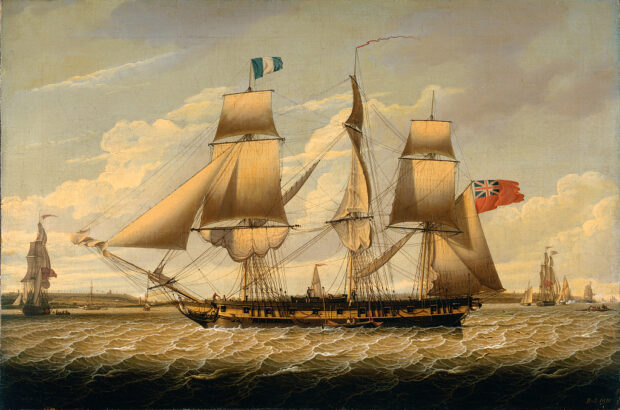
the square sail on the fore and mainmasts,
and a lateen sail on the mizzen (the mast at the stern). The square sails filled
like parachutes and propelled the ship at maximum
efficiency. The slimmer Portuguese caravels had
some northern influences from the cog, such as
the strong, straight keel or backbone instead of a curved one. Most caravels
had two masts and a substantial deck to make it seaworthy and strong enough to carry
deck-mounted guns. These ships were no more than
100 feet long with a small poop (a raised section at the stern) containing the
captain's cabin.
Longer and longer voyages required bigger ships
with more cargo and crew space. Ferdinand Magellan
could not have sailed around the world in a caravel.
By the end of the fifteenth century, caravels
were not commonly used.
Portuguese
explorers | Portuguese
Ships | Navigation
Methods | 15th-century
maps & charts |