- This Page Sponsored by:
  Mr. John Huntzinger
of Woodbridge, VA.
click here >
About the Library
Collections Overview
Search Catalogs
Chris-Craft
Plans & Drawings
Research Assistance
Support the Library
What's New


flotsam and jetsam

Exploration, Voyages of Discovery & Travel

How did the Niña, Pinta and the Santa Maria get their names?

The names of Christopher Columbus’ (1451-1506) three ships are quite well known. But how they got these names is not. The Santa Maria, Columbus’ flagship on his first voyage to the New World, translates to “Saint Mary,” and refers to the Virgin Mary, one of the patron saints of Spain. The smallest ship Niña, was officially named the Santa Clara, after the patron saint of Moguer, the Spanish town where she was built. The name Niña most likely comes from a feminine nickname for her owner, Juan Niño. The Pinta was Columbus’ fastest ship, but the origin of her name remains something of a mystery.

Samuel Eliot Morison (1887-1976), an eminent maritime historian and author of Admiral of the Ocean Sea, theorizes that the name Pinta is derived from the maiden name of owner Christobal Quintero’s wife. She was part of the Pinto family of the city of Palos, and the name Pinta may derive from a family nickname.

Sources: Bedini, Silvio. The Christopher Columbus Encyclopedia. New York: Simon and Schuster. 1992.
Morison, Samuel Eliot. Admiral of the Ocean Sea. 2 vols. Boston: Little, Brown and Company, 1942.

Who was the first person to circumnavigate the world?

While Ferdinand Magellan (c.1480-1521) is commonly credited with being the first person to have sailed around the world, it must be remembered that he died in the Philippines before completing the historic voyage. Magellan, a veteran explorer of the East Indies, was tapped by Spanish king Charles I (1500-1558) in 1517 to sail west in order to reach the Indies, thereby accomplishing what Christopher Columbus had set out to do in 1492.

After two mutinies, a treacherous passage through South America (through the straights later named for Magellan) and a scurvy-filled voyage across the vast Pacific Ocean (which Magellan named) the fleet eventually arrived in the Philippines. Relations between the Europeans and the locals quickly soured and Magellan was killed in battle. Command of the expedition eventually fell to a Basque mariner named Juan Sebastian de Elcano (c.1474-1526), who set sail with roughly 50 members of the original 250 man crew in the only slightly seaworthy carrack Victoria.

The fleet’s other remaining vessel, the Trinidad, stayed in the Indies and was unable to return to Europe. Elcano’s voyage took roughly a year to sail across the Indian Ocean, past Africa and back to Spain. Within the Victoria’s rotting hull was a fortune in spices and the seventeen survivors of the expedition. While Magellan was posthumously praised for leading the expedition, Elcano was rewarded with a lifetime pension and a coat of arms from the Spanish crown.

Source: Bohlander, Richard, ed. World Explorers and Discoverers. New York: Macmillan Publishing Company, 1991

Why was America named for Amerigo Vespucci?

Christopher Columbus (1451-1506) was credited with discovering the New World for many years. Then why were two continents named after a relatively little-known bibliophile and cosmographer from Florence, Italy? Amerigo Vespucci (1451-1512) was in Seville, Spain in 1496 when he first met explorer Christopher Columbus. The two became friends, and Vespucci used his position as a ship broker in Seville to get attached to an expedition heading for the New World.

German cartographer Martin Waldseemuller (c.1475-c.1522) read of Vespucci’s voyage and drew a map based on the most up-to-date information available in which he labeled the New World “America” in honor of Vespucci. The Spanish, however, continued to refer to South America as “Columbia” into the 18th century, but finally succumbed to the principal of common usage and began calling the continent America.

Source: Hendrickson, Robert. Salty Words. New York: Hearst Marine Books, 1984.

Who was Christopher Newport?

Christopher Newport (1560-1617) was an eminent Elizabethan mariner who spent the better part of his career treading the thin line that separated merchant adventurer and out-and-out pirate. While no records exist to prove it, Newport most likely went to sea at a young age. By 1581, he was part of an English expedition illegally trying to trade with Portuguese settlers in Brazil. After partaking in some looting with famed privateer Francis Drake (1540-1596), Newport was given command of his own privateering vessel. Newport turned out to be very adept at this vocation. Even after losing his right arm in a battle with the Spanish near Cuba, Newport continued to raid Spanish shipping throughout the Caribbean for more than ten years.

When, in 1606, the Virginia Company was ready to send a group of settlers to the New World, Christopher Newport was an obvious choice to lead the expedition. In 1607, Newport set sail with three ships, the Godspeed, Discovery and the Susan Constant with the men who would found Jamestown, England’s first permanent colony in America. Newport’s sound judgment, along with his impeccable timing, would serve the Virginia Company well for six years. By 1612, Newport was employed by the East India Company and began making trading expeditions to the Indies. He died at Bantam (in present day Indonesia) in 1617.

Sources: Andrews, K.R. 1954. Christopher Newport of Limehouse, Mariner. William and Mary Quarterly 11:28-41.

Who was the first European to sail around Africa?

When looking at a modern-day map of the world, sailing around the southern tip of Africa appears to be a relatively easy thing to do. But to the 15th century Portuguese explorers who hoped to trade in the East Indies, it was a daunting proposition. In 1487, Bartholomeu Dias (c.1450-1500) set sail on the orders of Portuguese king John II (1455-1495) to explore the African coastline and determine if Africa could be sailed past. At this time, there were some Europeans who believed that Africa and India might be connected, or that the southern coast of Africa was entirely impassable. Dias and his men sailed south and determined that Africa and India were not connected, and that the Indies could be reached by sea from Europe. But sailors are a superstitious lot, and Dias’ terrified crew insisted that he return to Portugal.

King John was pleased that Portugal now had access to the riches of the Orient. All he needed was for someone to actually sail there. That someone would be Vasco da Gama (c.1460-1524). In 1497, da Gama, an experienced mariner, set off for the Indies, intending to push past Africa. After an arduous journey past the Cape of Good Hope (discovered and named by his predecessor Dias) and up the eastern coast of Africa, da Gama and his fleet of three ships (a fourth had been destroyed on the voyage), found themselves in India, where they traded for spices and jewels. They also engaged in some skirmishes with the locals.


The voyage was a commercial success, and the Africans, Arabs and Indians alike learned to both fear and respect the Portuguese explorers.

Sources: Bohlander, Richard, ed. World Explorers and Discoverers. New York: Macmillan Publishing Company, 1991.

Did Leif Eriksson discover America?

Strictly speaking, the American continents had already been “discovered” by the time the Europeans showed up. But to the Europeans who came upon these lands, they seemed to be new discoveries. The Vikings, a dynamic group of sea rovers from Scandinavia, were the first Europeans to “discover” America. Around 985, Bjarni Herjolfsson (fl. c.985), a Viking merchant from Iceland, was sailing for Greenland, by then a Viking colony. He missed Greenland, but eventually found himself off a densely forested coastline. Bjarni knew he wasn’t in Greenland because Greenland had no dense forests. But Bjarni wasn’t too curious about the land he’d found; he was more eager to get to Greenland and start farming.

About fifteen years later, around the year 1000, a more adventurous soul than Bjarni Herjolfsson set sail and wound up off a new world. Leif Eriksson (c.985-c.1020), a Greenlander with a yen for travel, wanted to find out more about the land that Bjarni had been criticized for not exploring. The first place Leif found himself in was a rocky shore he called “Helluland” which translates to the unromantic term “slab land.” Further south, Eriksson dubbed the area “Markland”, meaning “forest land.” Historians believe that these sites are modern day Baffin Island and Labrador, respectively. Leif’s final destination in the New World was a place he called “Vinland”, named for the numerous vines the Greenlanders found there.

The actual location of Vinland remains a mystery, but many place it somewhere in Newfoundland, Canada. The Vikings failed to establish anything permanent in Vinland, and a subsequent attempt to settle there was abandoned due to the inability of the Vikings to peacefully coexist with the indigenous native population.

Sources: Haywood, John. Encyclopedia of the Viking Age. New York City: Thames & Hudson, 2000.

Culture of the Sea

When did mariners begin using the telescope?

The telescope was invented in 1608 by Dutch spectacle maker Jan Lippershey and later refined by famed scientist Galileo (1564-1647). Its military use was readily apparent, and by the mid-17th century they were being used aboard ships. The telescope (a term supposedly devised by Galileo) went by many names at sea. The English referred to it as the "Dutch trunk" and the "trunke spectacle" as well as the more familiar term "spyglass."

Sources: Bell, Louis. The Telescope. New York: McGraw-Hill Book Company, 1922. Kemp, Peter, ed.

The Oxford Companion to Ships and the Sea. London: Oxford University Press, 1976

How were burials at sea performed?

During the days of the big sailing ships, it was inevitable that crewmen would die while at sea. Bad food, dangerous duties and the ever-present threat of disease in cramped living conditions made life at sea a perilous career choice. When a man died at sea, there usually was not a coffin available for the body. Instead, the ship’s sailmaker would wrap the remains in extra sail canvas and sew it shut. It is said that final stitch was often passed through the dead man’s nose. All crewmen who were not on duty were expected to attend the funeral, with the dead man’s friends and mates often receiving time off to attend. The ship’s chaplain or captain would say a few words from a prayer book or the Bible, and then the canvas-wrapped body would be tipped overboard into the ocean.

Sources: Lovette, Leland P. Naval Customs, Traditions and Usage. Annapolis: United States Naval Institute, 1934.

What’s the story behind the Flying Dutchman?

The legend of the Flying Dutchman, and its many variations, is one of the best known superstitions of the sea. The story goes that a Dutch sea captain (his name is sometimes given as Vandedecker) in the 17th century made such fast voyages between Batavia in the Dutch East Indies and Europe that his sailors believed that he was in league with the Devil. On one trip, his ship (sometimes called the Braave; often no ship name is given) was having trouble passing the Cape of Good Hope at the tip of Africa.

Vandedecker was so enraged that he mocked God and was sentenced to wander the seas forever, never reaching Amsterdam. As time wore on, the legend expanded so that Vandedecker (and, by extension, his ship) were considered ghostly bad omens to other sailors. Anyone who sights the Flying Dutchman is said to be marked for a fast death.

The story is a legend based on other, more terrestrial, legends about unlucky people who are punished for their impertinence by being forced to wander the earth aimlessly. Seeing these spectral nomads normally indicates bad luck is on the horizon.

Sources: Beck, Horace. Folklore and the Sea. Edison, NJ: Castle Books, 1999.

Rabl, S.S. 1948. The Legend of the Flying Dutchman. The Chesapeake Skipper. Vol. 2, No.5: 9, 33

What is grog?

There are few beverages in the world so uniquely maritime as grog. Little more than watered-down rum, grog seems an inseparable part of life at sea in the Age of Sail. In 1739, Vice Admiral Edward Vernon (1684-1757) of the Royal Navy issued a decree that the crew’s normal ration of rum (plentiful in the Caribbean, where Vernon and his fleet were stationed) would be diluted with water. The new drink would consist of a half-pint of rum and a quart of water. Though they were drinking something less potent than straight rum (which, in the Caribbean, tended to be very strong), the seamen of the Royal Navy did not put up too much of a fuss. Vernon was a capable and much respected leader, and his men dubbed the concoction “grog” in his honor. While pacing the deck of his ship, Vice Admiral Vernon was rarely seen without his old grogram coat, leading to the nickname of “Old Grog.”

One of Edward Vernon’s subordinates was a Virginian named Lawrence Washington (1718-1753). The two became such good friends during a naval campaign in the Caribbean, that Lawrence Washington would later name his Virginia estate after his old comrade. After Lawrence Washington died, ownership of the Mount Vernon plantation eventually passed to his brother George.

Source: Lathrop, Constance. 1935. Grog: Its Origin and Use in the United States Navy. United States Naval Institute Proceedings. Vol.61, No.385: 377-80.

Is it true you should only eat oysters in months that contain an R?

Some would argue it is never a good time to eat oysters, but that is a separate matter entirely. The old maxim goes that oysters should never be eaten in May, June, July or August because these months do not have an R in their names. This is not due to the oysters being in any way dangerous to eat, rather it is because these months tend to be when the oyster breeds. The ban on eating oysters during their breeding period goes back hundreds of years. To protect precious oyster beds, England’s King Edward III (1312-1377) decreed in 1375 that it was against the law to catch or possess oysters between the months of May and September.

Many modern seafood connoisseurs still pay lip-service to this old custom; perhaps the idea of King Edward’s displeasure keeps them honest.

Source: Cowan, Frank. A Dictionary of the Proverbs and Proverbial Phrases of the English Language Relating to the Sea. Greensburgh, PA: Oliver Publishing House, 1894.

What is a bo’sun’s whistle?

During the days of sailing vessels, the boatswain (contracted, in typical sailor fashion, to “bo’sun”) was responsible for ensuring that the work done on deck (and up in the rigging) was done correctly. No sailor wanted to face the unpleasant wrath of an upset bo’sun. So that his orders could be heard, the bo’sun was normally equipped with a whistle. Specific tunes (or “calls”) would correspond to specific orders. The unique whistle (which resembles an oddly-shaped tobacco pipe) became the badge of the bo’sun throughout the 16th and 17th centuries.

Legend has it that England’s Lord High Admiral Sir Edward Howard (c.1477-1513) wore a similar whistle to commemorate a crushing naval victory over Scottish captain Andrew Barton (d. 1511). Howard’s pipe was no doubt a very ornamental affair; the ones later adopted by bo’suns were modeled after Sir Edward’s, but were much more modest.

Although modern public address systems have taken the place of the bo’sun’s whistle, it is still used on special occasions to announce the arrival of a VIP onboard a ship.

Sources: Kemp, Peter, ed. The Oxford Companion to Ships and the Sea. London: Oxford University Press, 1976.

Stephen, Leslie, ed. The Dictionary of National Biography. London: Smith, Elder and Company, 1885.

What is the purpose of a figurehead?

Few things appear as uniquely nautical as the figurehead. Often a carved representation of the vessel’s name, or a personification of a vessel with an abstract name, the figurehead’s origins are as old as organized sea travel. Early on, a ship’s figurehead might invoke a protector spirit or deity to help ensure a safe and prosperous voyage. Ancient Egyptians and Phoenicians were the first to mount small, carved figures at the beakhead at the front of their ships, usually a bird or horse. Vikings continued this tradition into the Middle Ages with carvings depicting fearsome serpents or dragons incorporated into the design of their ships. By the 16th century, the design of ships had changed to allow figureheads (which, by now, were becoming more and more ornate) to move to their familiar position on the ship, just under the bowsprit.

The British, with their large navy, had dozens of names and subjects, both mythological and zoological, to choose from. The Spanish tended to use lions for figureheads, while the French focused on mythological subjects. What had started as a talisman of sympathetic magic, had transformed, by the age of sail, into a true work of art. The clipper ship era (in the mid-nineteenth century) ushered in a new wave of figurehead carving, in which women were the most popular subjects.

With the advent of steam, ships lost their bowsprit, and figureheads lost their home. By the twentieth century, figureheads joined the ranks of other aspects of the romantic age of sail that were remembered only by the old salts.

Sources: Kemp, Peter, ed. The Oxford Companion to Ships and the Sea. London: Oxford University Press, 1976.

Who was the inspiration for Moby Dick?

Moby Dick instantly comes to mind as one of the most recognizable cetaceans in history. But this frightening sea monster was not merely a figment of author Herman Melville’s (1819-1891) imagination. The real sperm whale who inspired Melville, and terrified a generation of whalemen, was a huge, seventy-foot long bull dubbed “Mocha Dick.” Dick was first encountered near the Chilean island of Mocha in the early 1800s, where he aggressively defended his turf against whalers and was known to smash whaleboats to pieces. Legends about Mocha Dick grew over a thirty year period, as Dick continued to attack whaleboats and even the occasional ship. Like the fictional Moby Dick, Mocha Dick was said to have numerous harpoons permanently stuck into his hide from many a fiercely fought battle against whalers.

It was not uncommon for whalers to name particularly ornery whales. The anthropomorphizing of their prey may have led to more involved stories featuring other named (and violent) whales, such as Timor Jack, Don Miguel, New Zealand Tom and Morquan, King of Japan. All of these whale celebrities are mentioned by Ishmael in Moby Dick.

Sources: Melville, Herman. Moby Dick, or the Whale. New York City: W.W. Norton & Company, Inc., 1967.

Whipple, A.B.C. The Whalers. Alexandria, VA: Time-Life Books, 1979.

What is the purpose of a sea shanty?

The sea shanty (also called a sea chanty) often invokes romantic images of the old clipper ships and the heyday of sailing vessels. But shanties were not created merely to add atmosphere to the arduous life of a shellback. Sailors spent an amazing amount of time pulling on ropes (“lines” to your average mid-19th century sailor), and only by an entire team of men pulling in time could the sails or capstans be handled correctly. A shanty gave the men a rhythm to pull to, and something to keep their minds off the tedious work.

Most songs were set to popular tunes of the day, and often reflected the topics foremost in a sailor’s mind: shore leave, women and drink. Shanties, a corruption of the French word chanter (“to sing”), largely died out by the 20th century, when steamships replaced sailing vessels. With no lines to pull, sailors had little incentive to dream up new shanties. The old songs live on, however, and offer an interesting view into the bygone world of the men who worked the old sailing ships.

Sources: Brown, Rosalina. 1999. Sea, Sailing and Song. Sea Breezes. 73: 290.

Swensen, P.R. 1987. The Origin of the Sea Shanty in Nautical History. The Dog Watch. 44:78-79.

Who was Davy Jones? Did he have a locker?

For centuries, sailors have personified death as Davy Jones, a ghoulish sea-demon who would pull the unlucky down to their deaths into the inky black sea. The origin of the name is unclear, but there are a few theories. One suggests that it comes from the name of a tavern-keeper mentioned in an old drinking song, who kept his beer and ale in a seaman’s chest. The more commonly agreed upon theory is that “Jones” refers to Jonah, the Biblical prophet who was swallowed by a whale.

Over time, sailors may have attached more menacing qualities to the character of Jonah than the Bible ascribes to him and turned him into something of a monster. Saint David was the patron of Wales, and Welsh sailors often turned to him in their time of need. How the pernicious Jonah and the redemptive Welsh saint were combined into one sinister character is unclear.

Most seamen carried their few belongings in chests or lockers. Davy Jones was no different, and his “locker” has come to represent the depths of the dark, ominous ocean.

Source: Hendrickson, Robert. Salty Words. New York: Hearst Marine Books, 1984.

Where does the word “hurricane” come from? How about “typhoon”?

This word came to us via Spanish interaction with the Tainos in the early 16th century. The Tainos were the “Indians” Christopher Columbus found when he landed in the New World. Their word for the large cyclonic storms (as well as a destructive creator god) which plague the Atlantic was written by early Spanish settlers as “huracan.” After some mistranslations and evolution, the word became “hurricane” in English by mid-17th century.

The word “typhoon” is an Anglicization of the Chinese word t’ai-fun, which means “great wind.”

Sources: Lovette, Leland P. Naval Customs Traditions and Usage. Annapolis: United States Naval Institute, 1934.

Rouse, Irving. The Tainos: Rise and Decline of the People Who Greeted Columbus. New Haven: Yale University Press, 1992.

Harbors & Ports

Where did Newport News get such an odd name?

The simple answer is that no one really knows where the name “Newport News” came from. But there is certainly no shortage of explanations. The most commonly held belief is that somewhere along the span of Newport News’ riverfront was a watering spot for ships on their way to the English settlement at Jamestown. According to legend, this is where Christopher Newport (1560-1617) landed and gave the homesick English “news” about what was going on in England. It has also been said that the English christened the point of land now known as Newport News Point “Newport’s Ness,” “ness” being an old-fashioned word for a spit of land. The city was called “Newport’s News” by some until the early 20th century.

But Captain Christopher Newport is not the only one given credit for the city’s name. Some say that a pair of early English settlers, the Newce brothers, are responsible for the name. New Port Newce was eventually corrupted over the years to Newport News. To further complicate matters, the Thomas and his brother William Newce were from Newcetown, Ireland. Still others contend that the name derives from the hometown of settler Daniel Gookin, who was from Newport, Ireland.

Sources: Evans, Cerinda. 1947. Newport News: Origin of the Name. The Virginia Historical Magazine 55:31-44.

Immigration & Slave Trade

When were the first African slaves brought to North America?

Spain’s newly conquered American empire required a huge workforce to tend the fields and toil in the mines. Local native were utilized first, but European diseases and unspeakably bad working conditions quickly took their toll on the population. In 1518, King Charles of Spain (1500-1558) allowed for some 4,000 Africans to be brought over to Spanish colonies to work the land. North America (specifically the present day United States) received its first influx of African slaves in 1526 with the arrival of Spaniard Lucas Vasquez de Ayllon (c.1475-1526) in present day North or South Carolina. Along with the 500 Spanish colonists of the expedition came some 100 African slaves meant to work the land. Less than a year later, malaria, mutiny and an unseasonably cold winter killed off the majority of the Spanish, including Ayllon himself.

Source: Quattlebaum, Paul. The Land Called Chicora. Gainesville: University of Florida Press, 1956.

The Mariners’ Museum

Who founded the Mariners’ Museum?

By 1929, Archer Huntington (1870-1955), heir to a fortune of his father Collis Huntington (1821-1900), decided he wanted to build a spectacular maritime museum. It was decided that Newport News, Virginia, home to the shipyard his father had constructed, would be the perfect location. In 1930, Huntington began buying up land along the James River to house his museum and the Commonwealth of Virginia granted him a charter which created the Mariners’ Museum.

The local Newport News Shipbuilding and Drydock Company (at this time, still controlled by the Huntingtons) provided much engineering and building skills, and by 1933, the Museum was ready to open to the public. There was no fanfare on October 29, 1933 when the first guests (who happened to be anyone visiting the already popular Mariners’ Museum park) were admitted in to see the rudimentary display of nautical artifacts.

Source: Brown, Alexander Crosby. The Mariners’ Museum, 1930-1950: A History and Guide. Newport News: The Mariners’ Museum, 1950.

How did Collis Huntington make his fortune?

Like many Americans, Collis Potter Huntington (1821-1900) headed west during the California gold rush in 1849. But he was not out to sit in a stream, panning for gold. Rather, he was content to play the role of merchant, selling goods and merchandise to the miners and prospectors. A shrewd businessman with an almost innate ability to turn a profit, Huntington soon established himself as one of the West’s most prosperous businessmen.

Not content to rest on his laurels, Huntington joined a group of three other like-minded California entrepreneurs during the American Civil War (1861-1865) to petition the United States government to build a trans-continental railroad. Huntington was Central Pacific’s main cheerleader in Washington DC during the early days of the war, and in 1862, he was rewarded with a contract to construct the railroad. Huntington then turned his sights south and formed the Southern Pacific to construct a railroad through the American Southwest. After absorbing and/or buying up numerous smaller railroad companies and even a few shipping firms, Huntington purchased the Chesapeake and Ohio (C&O) railroad. He now owned a second trans-continental line, that ran from Virginia in the east, south to New Orleans and from there, west to California.

By the 1880s, Huntington was running coal from his mines in Appalachia to Newport News, the terminus of his C&O line. It was in Newport News that he founded the Chesapeake Dry Dock and Construction Company in 1886 to add shipbuilding to his impressive industrial resume. The company later became the Newport News Shipbuilding and Drydock Company, a leader in the construction of civilian passenger liners and military aircraft carriers.

Source: Miles, George E. Collis P. Huntington. (n.p., 1899)

Who carved the lion statues on the Lions’ Bridge?

The Lions’ Bridge (which is technically a dam rather than a bridge) separates the Mariners’ Museum’s Lake Maury from the James River. It is so named for the four lifelike lion statues that adorn each of its corners. The lions were designed by renown sculptress Anna Hyatt Huntington (1876-1973), wife of the Museum’s founder, Archer Huntington (1870-1955).

By the early 1930s, when the lions were delivered to the Museum, most of the actual carving of Mrs. Huntington’s designs was being done by skilled craftsman Robert A. Baillie (b.1880). Baillie, a native of Scotland who came from a revered family of stone carvers, created the four lions out of limestone at his studio in Closter, New Jersey. He oversaw their placement on the bridge by riggers from the nearby Huntington-owned Newport News Shipbuilding and Drydock Company in 1932.

Sources: Brown, Alexander Crosby. The Mariners’ Museum, 1930-1950: A History and Guide. Newport News: The Mariners’ Museum, 1950.

Proske, Beatrice Gilman. Robert A. Baillie: Carver of Stone. Brookgreen, South Carolina: Brookgreen Gardens Trustees, 1946.

Is Lake Maury a natural lake?

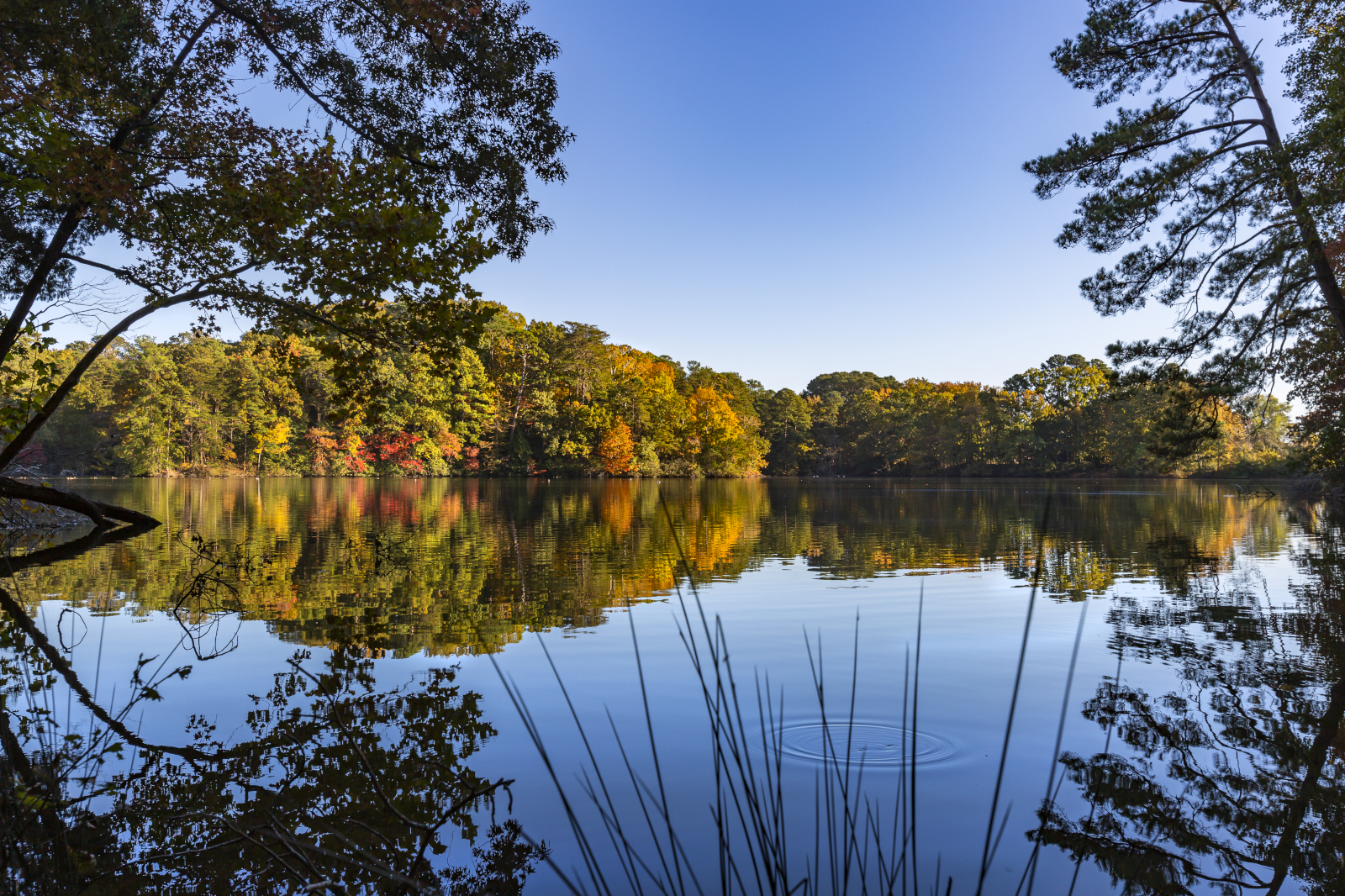
When the Mariners’ Museum was conceived in the late 1920s, the plan called for the inclusion of a large lake on the property. Local Waters Creek, named for early Virginia settler Lieutenant Edward Waters (b.1584), would prove to be the nucleus of the new lake. The creek was dammed up by engineers (the dam is now known as the Lions’ Bridge on account of the four lion statues decorating its corners), and water let in from the James River, along with two artesian wells, created Lake Maury.

Sources: Brown, Alexander Crosby. The Mariners’ Museum, 1930-1950: A History and Guide. Newport News: The Mariners’ Museum, 1950.

Cones, Harold N. The Mariners’ Museum Park: The Making of an Urban Oasis. Newport News: The Mariners’ Museum, 2001.

Who is Lake Maury named for?

Matthew Fontaine Maury (1806-1873) is often called the “Pathfinder of the Seas” for his pioneering work in the field of oceanography. Maury’s active career at sea ended in 1839 when an injury prevented him from serving aboard Navy ships. He was transferred to the Navy’s Depot of Charts and Instruments, where an interest in ocean currents and weather turned into an exhaustive study of oceanographic and meteorological data collected by United States warships cruising the world’s oceans. The subsequent charts he produced became the standard aboard American and foreign ships, both naval and merchant.

When Maury’s native Virginia seceded from the Union in 1861, he went with it and was commissioned into the Virginia State Navy. A few weeks later, the state’s navy was merged into the larger Confederate States Navy, where Maury was instrumental in designing torpedoes (devices that are now referred to as mines) and purchasing ships abroad to serve as commerce raiders. After the Civil War (1861-1865), Maury obtained a teaching position at the Virginia Military Institute.

Source: Bohlander, Richard, ed. World Explorers and Discoverers. New York: Macmillan Publishing Company, 1991.

Current, Richard N., ed. Encyclopedia of the Confederacy. 4 vols. New York City: Simon and Schuster, 1993.

Maritime Commerce, Merchant Marine & Work Boats