The Mariners' Museum - Monitor: History and Legacy
The Mariners' Museum Defending the Seas

Sponsored by:
Bell Atlantic Logo

Monitor - History and Legacy

In the Monitor Turret 1
by S.D. Greene

March 9, 1862
Published in "Century", March 1885


Samuel Dana Greene, Lieutenant
From the Collections of The Mariners' Museum


Launching of the Monitor
From the Collections of The Mariners' Museum

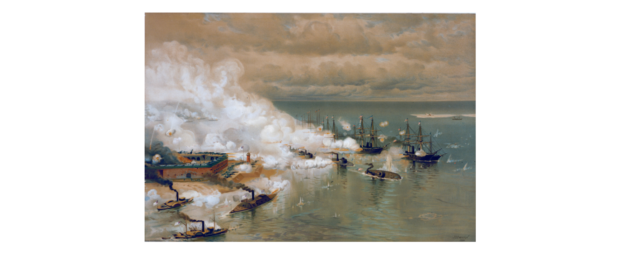
    The keel of the most famous vessel of modern times, Captain Ericsson's first iron-clad 2, was laid in the shipyard of Thomas F. Rowland, at Greenpoint, Brooklyn, in October, 1861, and on the 30th of January, 1862, the novel craft was launched. On the 25th of February she was commissioned and turned over to the Government, and nine days later left New York for Hampton Roads, where, on the 9th of March, occurred the memorable contest with the Merrimac. On her next venture on the open sea she foundered off Cape Hatteras in a gale of wind (December 29). During her career of less than a year, she had no fewer than five different commanders; but it was the fortune of the writer to serve as her only executive officer, standing upon her deck when she was launched, and leaving it but a few minutes before she sank.


John Worden, commander of the USS Monitor
From the Collections of The Mariners' Museum

    So hurried was the preparation of the Monitor that the mechanics worked upon her night and day up to the hour of her departure, and little opportunity was offered to drill the crew at the guns, to work the turret, and to become familiar with the other unusual features of the vessel. The crew was, in fact, composed of volunteers. Lieutenant Worden, having been authorized by the Navy Department to select his men from any ship-of-war in New York harbor, addressed the crews of the North Carolina and Sabine, stating fully to them the probable dangers of the passage to Hampton Roads and the certainty of having important service to perform after arriving. The sailors responded enthusiastically, many more volunteering than were required. Of the crew selected, Captain Worden said, in his official report of the engagement, "A better one no naval commander ever had the honor to command."


Berth deck of the Monitor
From the Collections of The Mariners' Museum

    We left New York in tow of the tug-boat Seth Low at 11 A.M. of Thursday, the 6th of March. On the following day a moderate breeze was encountered, and it was at once evident that the Monitor was unfit for a sea-going craft. Nothing but the subsidence of the wind prevented her from being shipwrecked before she reached Hampton Roads. The berth-deck hatch leaked in spite of all we could do, and the water came down under the turret like a waterfall. It would strike the pilot-house and go over the turret in beautiful curves, and it came through

Engine room of the Monitor
From the Collections of The Mariners' Museum

the narrow eye-holes in the pilothouse with such force as to knock the helmsman completely round from the wheel. The waves also broke over the blower-pipes, and the water came down through them in such quantities that the belts of the blower-engines slipped, and the engines consequently stopped for lack of artificial draught, without which, in such a confined place, the fires could not get air for combustion. Newton and Stimers, followed by the engineer's force, gallantly rushed into the engine-room and fire-room to remedy the evil, but they were unable to check the

Isaac Newton, 1st Assistant Engineer, USS Monitor
From the Collections of The Mariners' Museum

inflowing [sic] water, and were nearly suffocated with escaping gas. They were dragged out more dead than alive, and carried to the top of the turret, where the fresh air gradually revived them. The water continued to pour through the hawser-hole, and over and down the smoke-stacks and blower-pipes, in such quantities that there was imminent danger that the ship would founder. The steam-pumps

Alban Stimers, Chief Engineer, USS Monitor
From the Collections of The Mariners' Museum

could not be operated because the fires had been nearly extinguished, and the engine-room was uninhabitable on account of the suffocating gas with which it was filled. The hand-pumps were then rigged and worked, but they had not enough force to throw the water out through the top of the turret, — the only opening, — and it was useless to bail, as we had to pass the buckets up through the turret, which made it a very long operation. Fortunately, towards evening the wind and sea subsided, and, being again in smooth water, the engine was put in operation.

Monitor with the Congress in background
From the Collections of The Mariners' Museum

But at midnight, in passing over a shoal, rough water was again encountered, and our troubles were renewed, complicated this time with the jamming of the wheel-ropes, so that the safety of the ship depended entirely on the strength of the hawser which connected her with the tugboat The hawser, being new, held fast; but during the greater part of the night we were constantly engaged in fighting the leaks, until we reached smooth water again, just before daylight.


First Previous Next Last

Go to Main Category:
The Battle of Hampton Roads: March 8 & 9, 1862

Go to other documents in this category:
"The Battle of March 8, 1862" - H. Ashton Ramsey
"Watching the Merrimac" - R.E. Colston
"The Men of the Cumberland" - Rev. R.T.S. Lowell


[ Navigation Bar ]

Copyright © 1999 The Mariners' Museum. All Rights Reserved.